
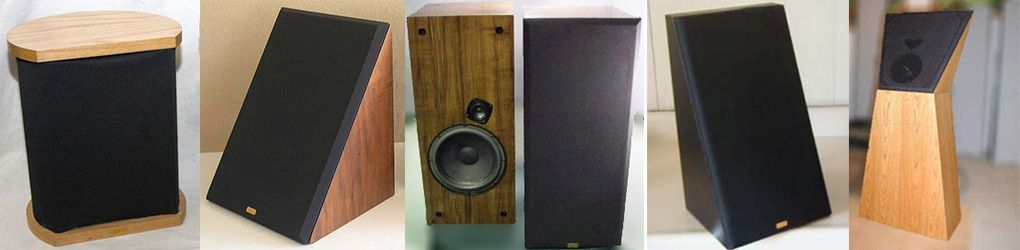
John Bau mentions in his interview with Oswaldo Martinez at EnjoyTheMusic.com that replacing the electrolytic capacitors with newer units is a good idea. Electrolytic caps do deteriorate and Bau suggest after 10 yrs that these may need to be replaced. There are several posts on SLUG where caps have physically opened up, much like a leaky battery. When this happens, you most likely will hear a difference and know there is a problem. It may even appear you have a bad driver, when all that is wrong is a dead capacitor. Caps may sound different as they age and deteriorate, but it may not be obvious when listening and there may be no visual queues.
Bau also suggests that metalized polypropylene capacitors would be a good way to go. Over the long haul, they don’t deteriorate and sonically they are very neutral. While this is technically a good idea, polypropylene caps are physically larger than electrolytics and mat require some minor rework of the circuit board to accommodate the physical differences. In email conversations with Bau, he said he had replaced the 'lytics in his TC60's and liked the results very much.
In addition to the labeled value, capacitors have electrical characteristics that affect the way they interact with other components in the crossover circuit. Metalized polypropylene caps have different (ESR) than their electrolytic counterparts. While my advise has been to stick with the electrolytics, as all the original circuitry has been optimized for these, John Bau responds:
Capacitor Values
While caps are available with a 1% tolerance, Spica used the less expensive 10% variety. Apparently, Bau used this to his advantage hand measuring and then binning like values and then matching left and right channel during assembly. Unfortunately, electrolytic caps drift dramatically with age. The best practice is to replace caps with the marked values (go by the values on your caps, not the values on the schematic). Measuring the actual values of the new caps to match the left and right channels as closely as possible (you will need a capacitance meter) is recommended. The original circuits were tuned further than this, but we don't have the Rosetta stone for matching at that level.
Note that caps that are connected in parallel combine electrically appear as a single value. Adding values together (1.5 uf + 0.5 uf = 2 uf) can help you achieve the more exact results. I suggest you measure each electrolytic and the mylar that parallels it as a unit and use that as your target replacement value.
Here are nominal ESR values (measured at 10kHz) for the Bennic bipolar caps used across the Spica line (from John Bau):
| Value/Voltage | Ohms @10Khz |
| 40uF/50V | 0.29 |
| 33uF/50V | 0.22 |
| 20uF/50V | 0.21 |
| 4.7uF/50V | 0.11 |
| 3.1uF/50V | 0.055 |
Ordering Capacitors
If you are just looking to repair your Spica's I would match and replace the existing caps with as close a match as possible. Spica used a lot of Bennic caps which are still widely available. Electrolytics come in polarized (for DC applications like power supplies) and non-polarized (for AC applications like speaker crossovers). If you stick with electrolytics, you will want non-polarized (or bi-Polar) caps. Metalized polypropylene are not polarized. There are also differing lead configurations for caps, you will see “radial” and “axial” varieties in the cap listings. Radial have both leads extending from one end of the unit, Axial have a lead extending from either end. While electrically identical, you will want Axial. leads. The factory electrolytics caps were rated at 50 volts (50V) so stay with those rated at 50v or greater.
In addition, to voltage and capacitance, most part listings will also include the physical dimensions of the cap and the lead length. You need to be sure the caps are short enough to fit the existing space and not so large in diameter as to interfere with adjacent components.
Note: There are some mylar caps on the boards, they are the smaller values and look different than the electrolytics (which look kind of like batteries). You should not need to replace the mylars for age reasons.
