
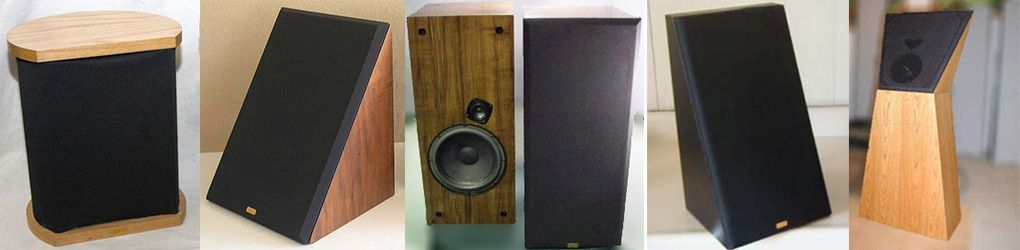
Replacement Woofers
The original drivers were manufactured by Audax (FR) / Polydax (US). Audax no longer manufactures replacement woofers. If you could find Spica graded new old stock (NOS) with the proper service codes and model number that would be ideal, perhaps just as good would be to cannibalize a used set with the same service codes. Other options include non-graded, NOS Audax (FR) / Polydax (US) replacements, which turn up on eBay from time to time, or getting your driver rewound by a rebuilder. If you go with non-graded drivers or chose to have your drivers rebuilt, there a strong case to have your drivers redone in pairs.
Note: If you are getting TC-50s off eBay for parts, be aware that the woofers, tweeters, and crossovers were not the same between early (TC50) and late (TC50i) models (see revision).
Replacement Tweeters
While woofers were individually graded and matched to the crossover circuit, tweeters were not graded. Any TC50 tweeter can be swapped with an other TC50 tweeter of the same model number driver (early and late are different) without introducing a crossover matching issue.
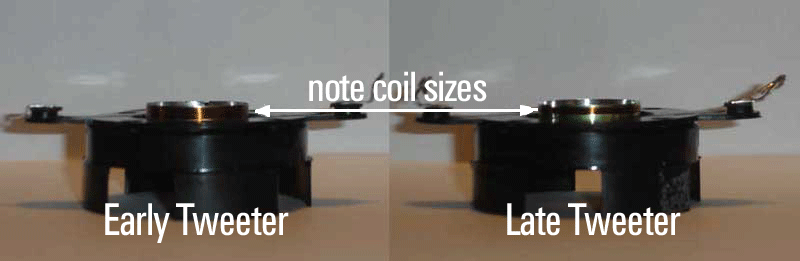
While original drivers have been unavailable for sometime, Madisound offers the Audax 4 ohm TW025A2 driver (specs) as a replacement tweeter for early and late units. Madisound's TW025A2 tweeter isn’t an exact replacement, but it's probably as close as you'll find. Pete Basel recommends adding a 2 ohm metal film (not carbon film or wire wound) resistor in series to better match it to the existing circuit. I do recommend you replace them in pairs to match left and right response.
Visually (based on the length of the voice coil), Madisound's TW025A2 tweeter appears to more closely match for the earlier the HD 100 D25 tweeter. There is a small fitment issue. The terminals on the original TC50 tweeters were 180 degrees apart (if the speaker were the face of a clock, the terminals would be at 3 and 9 o'clock), while the terminals on the TW025A2 tweeters are located 40 degrees apart (5 and 7 o'clock). The so some cabinet modification will be necessary.
Rebuilding \ Repairing Drivers
The voice coil of woofers and tweeters can be rewound by a competent speaker rebuilder. However, if you have a physically damaged cone or rubber surround you may be out of luck. Everyone I have contacted says the butyl surrounds for the woofers are no where to be found. This means a rebuilder will use foam surrounds. Foam surrounds will significantly alter the mass of the woofer and its sound.
Speaker Cone Doping
The woofers of the TC-50 and 50i were doped in a mix of Elmer's glue and water. According to the (SLUG Post 836), the Elmer's glue is mixed 60:40 glue to water (3:2). They first placed an 1/8" bead is put around the base of the cone and let it dry, then cone is coated. It is believed that the TC-50s had one coat, while TC-50i's had two coats (SLUG post 160).
