 Handy
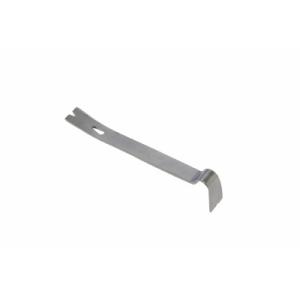
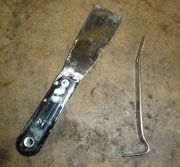
Tools for removing a driver: Putty Knife and nail-puller
Handy
Tools for removing a driver: Putty Knife and nail-puller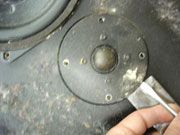 Tweeter
Removal
Tweeter
Removal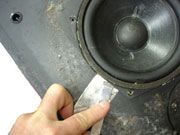 Woofer
Removal
Woofer
Removal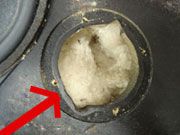 TC-50
Tweeter Gasket Detail
TC-50
Tweeter Gasket DetailWhat Can Go Wrong
Speakers are pretty durable, but failures do occur. The most common with TC-50's is a broken tweeter lead. In addition, over-driving the speakers or electrical problems in your amp can cause voice coils to overheat and become shorted. With age, paper surrounds and foam or rubber suspensions deteriorate and capacitors can dry out and fail, either degrading sound or causing a driver to just stop working.
Things to Check
Visually inspect the speaker, is the paper and surround in good shape (no deterioration, no holes, etc). The voice-coil floats within the magnetic field suspended by its surround. Woofers can be checked by gently pressing on the paper surround. Gently pressing the driver in it should move freely in and out (perpendicular to the frame). If it sounds like its got sand in it, its fried and it is time to find a rebuild/rewind shop. If it moves freely it may still be fried, but there is a greater likelihood that it has a broken lead. Note: The tweeters used in Spicas are too small to check using this method and must be removed to test.
Driver Removal
Once you have removed the screws, it just a matter of prying it out. However - there is usually a gasket beneath the driver. The gasket's job is to seal the enclosure making it airtight. This is important, as in non-ported enclosures, the air in the cabinet becomes part of the speaker's suspension. The issue is that this gasket may stick the whole works together making driver removal quite difficult. A heat gun (on low) or a hair drier may help un-stick the frame from the gasket. I recommend caution here as too much heat may damage the glue used on the driver itself.
Usually a flat-blade screwdriver is called into duty for this, but something broader and flatter is probably better. Work your way around the driver to loosen it, being careful not to pry so hard as to bend the frame of the driver. When you get ready to reinstall the driver, Caulk Cord (Mortite is a common brand), is a good gasket material that is easy to use.
It is often difficult to remove a woofer without deforming some of the particle board surround. I find that laying a putty knife under your pry bar helps spread the load and minimize damage to the surrounding wood. When the driver loosens it will be connected to the crossover with two wires. Note: Before disconnecting the driver, it is important to identify and mark which lead is connected to the positive terminal (this affects polarity).
The pry-bar I use is slim and chromed, similar to this: Vaughan 5-1/2 in. long Mini Bar Nail Puller available at hardware stores.
Testing Drivers
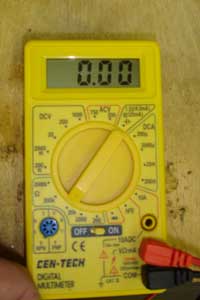
Woofers and tweeters can be tested with a Digital Multimeter (DMM) or Volt Ohm Meter (VOM). If you don't have a meter, you can get an inexpensive one for under $10 and they are great for basic troubleshooting. Nothing too mysterious here, the meter will have several tests it can perform, usually AC and DC Voltage (Volts 'V'), Current (Amps 'A'), and DC Resistance (Ohms 'Ω') with scales for each. What your are interested in is the Ohm function. Ohm may be abbreviated Greek Omega Ω character and the scale should be on the lowest scale (usually 200 ohms). The Ohm mode connects the meter's battery to its leads and measures the resistance of the circuit. When the leads are separated you will have infinite resistance (open), placing the leads together directly will measure zero ohms (shorted).
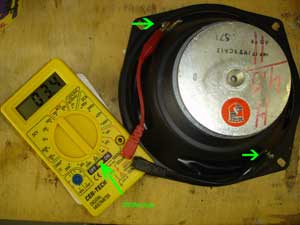
When you connect the leads of the meter to the woofer or tweeter terminals on a TC-50, it should measure a little more than 3 ohms (the resistance of the wire in the coil). A speakers DC impedance will always be less than the speakers rated "impedance" which is AC measurement that measures the average (nominal) resistance over an audio range. If a TC-50 measures less than 3 ohms is likely shorted (the winding insulation has overheated and fried), if it reads infinite, you may have an broken lead. Note: to get an accurate reading you must disconnect at least one of the speakers leads from the crossover, otherwise you will also be measuring the resistance of speaker and the crossover circuit. If it measures around 3 ohms, but you still don't have any sound, you may have a bad component in the crossover circuit or a broken lead. You can also try measuring from either of the leads to the metal frame. Zero ohms reading there would also indicate that the voice coil is shorted.
Another test you can perfrom on a woofer's voice coil is to see if it's binding: Hold the metal frame of driver with both hands (like a steering wheel) with the magnet facing away from you. Using your thumbs, gently push in evenly on either side of the paper cone surround (not the middle cap). If you’re applying pressure to the cone evenly, it should move easily in and out of the magnet. If it sticks, or you hear scraping, the voice coil is shot.
Replacement Woofer
While the only perfect woofer match for a set of Spica's is a service code matched OEM replacement. A bad voice coil can be rewound by a speaker re-builder (see links) and will likely produce a replacement driver that is a better match than a generic new old stock (NOS) Audax (FR) / Polydax (US) replacement.
Salvaging a Dead Tweeter
Tweeter failures can be mechanical or electrical (electrical being caused by overload and breakdown of the insulation). I have seen several tweeters that had mechanical failures. In most cases one of the leads will fatigue and break near the coil (you may note green oxidation at the point of failure). I have been able to salvage a tweeter when the negative lead that had failed by carefully uncoiling one turn of the coil and reconnecting the terminal. I was initially concerned about loss of resistance and inductance from this change, but found the measurements of the salvaged tweeter were in line with the measures those of other tweeters which have varied from 3.5 mH to 3.8 mH (inductance is measured in Henries) . While a new tweeter would be preferable, this is a serviceable option. Note: Please see my page on Driver Replacement as it contains important information about using the Audax TW0 25 A2 tweeter avilable from Madisound.
Another source of mechanical failure in a tweeter is the is piece of foam that lies beneath the fabric dome. The dome shaped piece of foam can deteriorate and crumble into the grove between the coil and the magnet. This deterioration appears to be accelerated in Spicas that have been stored in a hot, un-air conditioned space. I don't know if this foam dome can be obtained from a re-builder or not, but this is an area you may want to check, especially if your speakers are particularly old or have been stored in hot spaces.
Determining Polarity
Correct polarity is required to keep drivers in phase (reversing the leads, produces a signal 180 degrees out of phase). You can determine polarity of a woofer by connecting a wire to the negative side and one to the positive side of a "d-cell' battery and then connect the wires to the speaker terminals. When the positive lead is connected to the positive speaker lead, the cone will move forward, if it is connected to the negative lead, the cone will move back. The battery method doesn't work for tweeters.
I found that after removing a tweeter I was unable to tell the positive terminal (normally marked in red) from the negative terminal. I went to my stash of parts to see if I see any clues that would help me identify the positive from negative terminals. Both leads attach to the coil at the edge nearest the dome. I found that there is a visible split in the form that the coil is wound around. The positive lead is the one that feeds into the spit. The positive lead enters the split, tucking behind the coil and looping up to start the coil at the edge farthest away from the dome.